teache vs Fayol lesson notes
A Fayol pack is the same file for every teacher who buys it. teache writes each week's lesson note for your own class: your periods, the indicators you are actually on, your school's header and a space for your headteacher to approve and sign. Your first 10 weekly notes are free.
Ready-made packs became the habit for a good reason. A lesson note is a week of work on paper, it is due before the week starts, and a pack gets it off your desk in one download. The trouble starts on Monday morning, when the pack's week and your class's week are not the same week. The periods are a different length, the class is still on last week's indicator, and the note you hand in describes lessons you are not going to teach. teache was built so the note you hand in is the week you actually teach, without writing it all by hand.
teache vs Fayol: which should you pick?
Both give you NaCCA lesson notes. The difference is who they are written for. A Fayol pack is written once, for every class at that level. teache writes each note for one class in one week, from what you tell it about that class. Here is how the two compare, feature by feature.
| Features | teache | Fayol |
|---|---|---|
| Lesson notes from the NaCCA curriculum | ✅ | ✅ |
| Written for your class | ✅ One week at a time | ❌ Same pack for every buyer |
| Your own lesson lengths | ✅ From your timetable | ❌ Fixed in the pack |
| Pick the indicators each week | ✅ | ❌ The pack's order |
| Starts where your class actually is | ✅ | ❌ |
| Headteacher approval space | ✅ On every note | ❌ None |
| Scheme of work | ✅ | ✅ |
| Record of work | ✅ Built from your notes | ❌ Not sold |
| Class tests on the lessons you taught | ✅ With answer keys | ❌ Ready-made tests only |
| A test paper only your class has | ✅ Written fresh for your class | ❌ The same paper is sold to anyone |
| A term of JHS notes, one subject | ✅ GH₵21 | ✅ GH₵45 |
| Free to start | ✅ 10 weekly notes | ❌ Pay per pack |
Why choose teache over Fayol?
A pack is written once for everyone. teache is written each week for you, from the timetable you teach and the indicators your class is on, and it keeps the rest of the term's paperwork in the same place. It comes down to three things: what you pay, how the note is made, and what else comes with it.
Pricing
teache
You pay per weekly note, 3 credits for one class and subject, with no subscription. You join with 30 free credits, enough for your first 10 notes, and get 5 more free every month.
A term of JHS notes for one subject costs GH₵21. You top up by Mobile Money or card when you need more, and you only pay for the weeks you actually build.
Fayol
You pay for each pack up front. A term of JHS notes for one subject costs GH₵45.
The price is the same whether you use every week of the pack or only some of them.
How the notes are made
teache
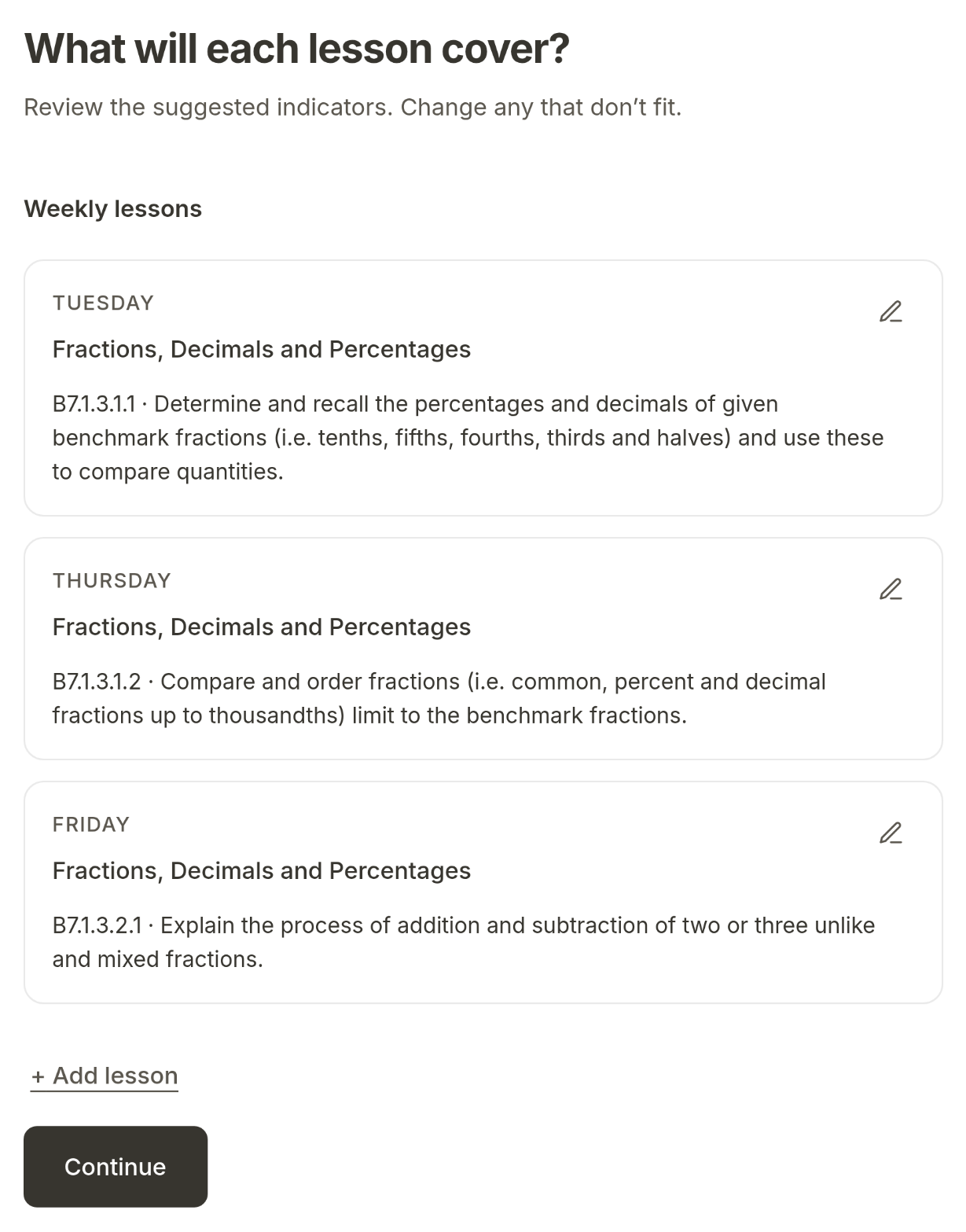
You tell teache once which periods you teach the class and how long each runs. Each week you tick the NaCCA indicators you are covering, and it writes that week's note around them: the right number of lessons, at the right lengths, on the days you teach.
If the class falls behind, you tick where it actually is and next week's note follows. Change anything you like, then print it or download it as Word or PDF.
Fayol
Fayol sells a finished pack, and every buyer gets the same file. The pack sets the lesson length (60 minutes in the Basic 4 pack we opened, 100 in the Basic 9 Science pack) and moves through the term in its own order.
If your timetable or your pace is different, the pack stays as it is, and the changes are yours to make.
Features
teache
Every note carries your school's details and a space for your headteacher to approve and sign after vetting, so it is ready to hand in as printed.
The same account writes your scheme of work, keeps the record of work from the notes you taught, and sets class tests with answer keys on the same lessons.
Each test is written fresh for your class, so the paper and its answers exist nowhere else.
Fayol
Fayol sells schemes of learning, ready-made end-of-month tests and exam questions alongside its notes. It does not sell a record of work, and neither pack we opened has a space for the headteacher's approval.
Its tests and marking schemes are on an open store, so the same paper and its answers are for sale to anyone who wants them.
Do more with teache
A lesson note is one document in a term full of them. These come with the same account, built from the same classes and the same notes:
Schemes of work
A full-year scheme for one class and academic year, with term tabs you can edit before you print.
Record of work
Built from the lesson notes you created, then left editable so it shows what was actually taught.
Class tests with answer keys
Set a test on the lessons you have taught, read it through, and print the paper and its key.
Start from a photo
Already have the week on paper? Attach a photo and teache turns it into the starting point.
Print, sign and file
A GES-style sheet with day and date rows and the approval space, ready for your headteacher.
On your phone
Build and check a week's note from your phone, the same as on a computer.
Start with a free week
Every account starts with 30 free credits, enough for 10 weekly notes. Set up one class, build next week's note, and put it beside the pack you would have bought. If it fits your week better, keep going. If it does not, you have spent nothing.
Frequently asked questions
Does teache follow the NaCCA curriculum?
Yes. You pick the strand, sub-strand and indicators from the NaCCA curriculum for your class and subject, and the note is written from those. The codes on your note are the codes in the curriculum.
Which classes does teache cover?
Basic 1 to Basic 9, across the subjects in the NaCCA curriculum for each level. It works for class teachers and subject teachers alike: add each class and subject you teach, and every note is built for that one.
Can I start from a scheme I already have?
Yes. Take a photo of the part of your scheme or notes you are working from, and teache reads it as the starting point for the week. How starting from a photo works.
Do I need a scheme of work first?
No. teache can write one for you, but it does not need one to write your note. What NaCCA expects of a scheme.
Can I change the note before I hand it in?
Yes. Edit anything in it, then print it, save it as a PDF, or download a Word file.
Will the note print the way my headteacher expects?
It prints on a GES-style sheet with your school's details, a row for each day and date, and the approval space at the end. Print, sign and file your notes.
What does a note cost after the free credits?
3 credits for a week's note for one class and subject, and you still get 5 free credits every month. There is no subscription; you top up when you need more. Current prices are on the pricing page.